Aimee Kurtz is the producer and executive producer of Death Punch TV, the backstage program The Mediatwist Group built around Five Finger Death Punch’s 2026 20th Anniversary World Tour, and runs the operations behind every Mediatwist production. She produced Sammy Hagar & The Circle’s “Funky Feng Shui” video with Mediatwist founder Chris Kurtz. Aimee leads the production side from the Rock Lititz campus in Lititz, Pennsylvania.
Executive summary
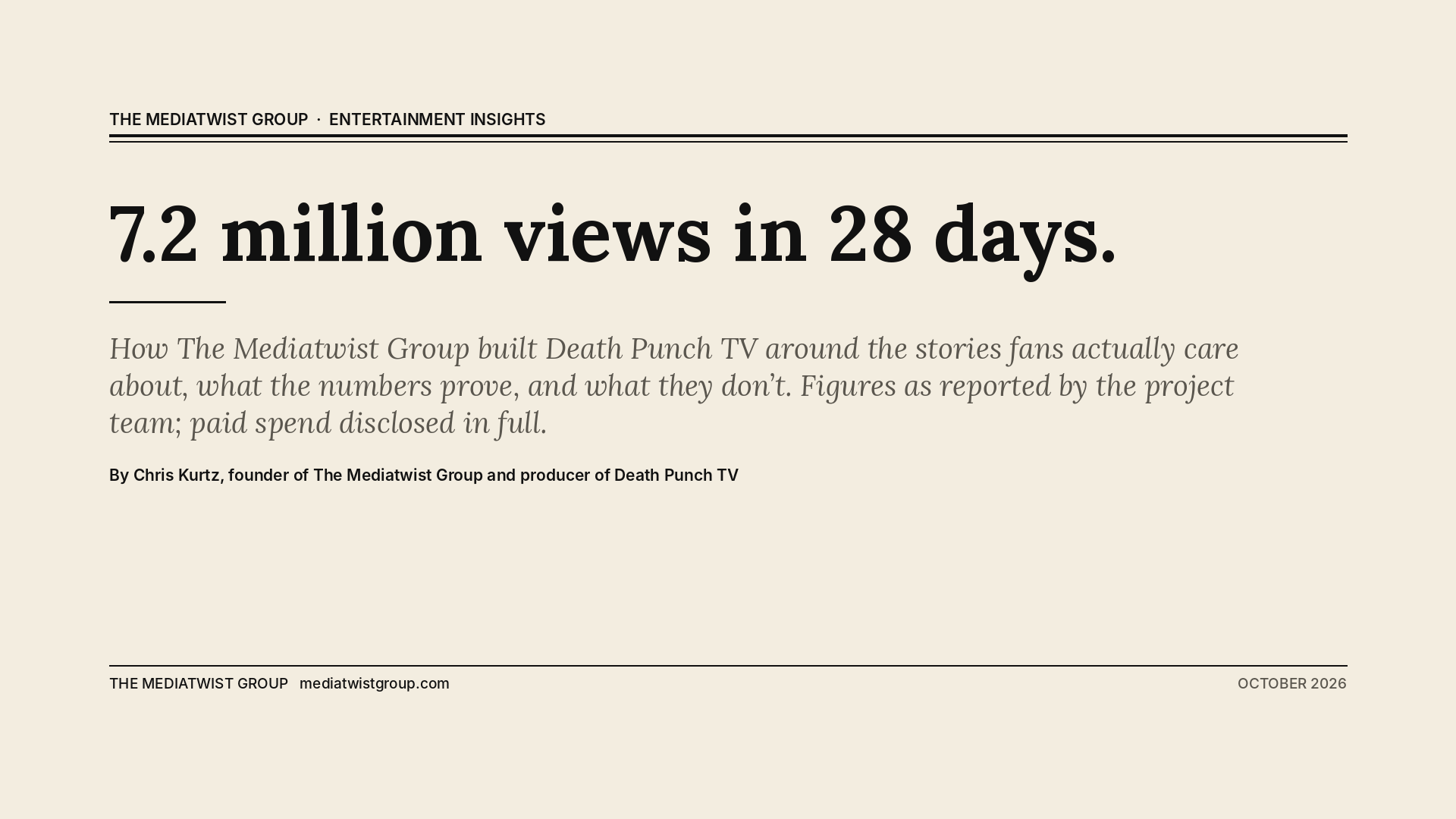
In the summer of 2026, Five Finger Death Punch launched a 48-city North American tour to mark twenty years as a band. Alongside it, The Mediatwist Group built Death Punch TV: a backstage content and broadcast program designed to show fans the people around the band rather than another highlight reel of the band. Over one 28-day window, the account's Instagram presence grew by roughly 20,000 followers and recorded more than 7.2 million views, according to Instagram Insights figures reported by the project team. What we can verify independently is narrower and, in some ways, more interesting: the paid-media contribution to that growth was negligible. The dedicated ad account for the band has spent under $1,000 in its lifetime, and its only broad awareness campaign recorded no Instagram follows at all. Whatever moved those numbers, it was not bought.
This article explains what Death Punch TV is, why it was built the way it was, what the metrics do and do not demonstrate, and what artist managers and touring professionals can take from it.
The observation that started it
Walk through any arena loading dock at 4 p.m. on a show day and you will see thirty stories nobody films. The drum tech who has built the same kit in a different city every night for a decade. The runner who has memorized which catering vendor in each market can handle the rider. The fan who drove nine hours and is standing at the barricade before doors with a sign about her brother. The band's social feed, meanwhile, is posting the same thing every other band posts: tour poster, ticket link, pyro clip, repeat.
Fans have seen the pyro. They have seen it from better angles than the band's own videographer can get, because 15,000 of them filmed it on their phones. The scarce thing on a tour is not footage of the performance. It is access to the hours around it.
That was the brief for Death Punch TV. Not a promotional channel. A program.
Why it was built
Five Finger Death Punch is a working band with a very large and very loyal audience. Pollstar's 2025 year-end analysis put the average Top 100 touring act at a record 19,104 tickets per show, with grosses down 6.1 percent from 2024's all-time high. In that market, the bands that keep filling rooms are the ones whose fans feel something about the band beyond the setlist. Twenty years in, the 5FDP audience already has the setlist memorized.
Two things made 2026 the right moment. First, the anniversary tour itself: 48 cities from Camden, New Jersey on July 20 to Bristow, Virginia on October 23, produced by Live Nation, with Cody Jinks and Eva Under Fire supporting, and a dollar from every ticket going to USA Judo and USA Cycling BMX ahead of the Los Angeles 2028 Games. That is a lot of nights and a lot of cities, which means a lot of raw material. Second, the band's relationship with its own catalogue. 5FDP re-recorded its biggest songs for two "Best Of" volumes after its original masters were sold without the band's involvement. A band that has decided to own its recordings is a band that understands why it should own its media.
How Mediatwist approached it
We treated Death Punch TV as a broadcast property with a format, not as a social media account with a posting schedule. Aimee Kurtz produced and executive produced the program, and the operational discipline described below is hers: Aimee set the run of show, the archive structure and the approval chain before the first load-in, and held the team to them for 48 cities. The distinction matters operationally.
Programming structure. Each tour stop is treated as an episode. Footage from the band's tour archive is organized by city and date, and each episode follows a fixed run of show: a cold open, a city segment, a crew or fan segment, a band-member segment, a merch or tour beat, and a close. Building to a fixed format means a three-person team can turn an episode in hours rather than days, because the decisions about structure were made once, in advance.
Identity. The program has its own logo, a skull-and-television mark, and a motion-graphics package of two dozen named transitions and bumpers built so that every episode opens and closes the same way. Fans learn the rhythm. The package was produced in-house using generative video tools against a strict rule: the logo artwork never changes, and nothing in the package may use the band's recordings or recognizable riffs. Original sound design only.
Human-interest first. The editorial rule for every segment: if the band is in the shot, the story is about someone else in the shot. A member talking about a crew member. A fan explaining why a song matters. A city explaining itself. The band appears constantly, but as a participant in other people's stories rather than as the subject of its own promotion.
Fan participation built into the feed. Comment keywords tied to each band member (IVAN, ZOLTAN, CHARLIE, CHRIS, ANDY) and to the anniversary (20YEARS, LEGACY) were designed to trigger automated Messenger conversations that deliver a digital trading card for that member, with a collect-all-five mechanic. The point is not the automation. The point is that a fan who comments "ZOLTAN" on a video about Zoltan has told the band something about herself, and the band can now talk back.
Short-form production. Vertical cuts are produced with a beat-synced editing pipeline that reads the music, scores the footage for energy and shot variety, and generates a first cut to the beat, which a human editor finishes. This is how one editor keeps up with a tour that plays five nights a week.
Live broadcasts. Episodes are also assembled as multi-scene live programs. The band streamed its Red Rocks show on September 9 as a ticketed live event; Death Punch TV's live programming around tour nights was promoted with small Facebook live-video boosts on September 12 and 28, at $9.77 and $42.09 respectively. Those two figures are the entire paid budget behind live programming in the period.
Collaboration between creative and marketing
The creative team and the paid-media team shared one rule: paid media may only amplify content that has already been published organically. No new ad creative, no repurposed copy. "Use existing post" or nothing. That rule does two things. It keeps the feed honest, because nothing runs as an ad that was not first offered to fans as content. And it makes attribution simple, because the paid line is tiny and traceable.
The paid program for the band was designed as a $500 month-one test with a pre-registered success metric (follower velocity before versus during paid), split $300 follower growth, $100 Death Punch TV engagement, $100 retargeting. In practice, the lifetime spend on the account through October 14 is below $1,000 across every campaign including the October ticket-sales sprints. The awareness campaign that ran August 25 to October 1 spent $349.08, reached 51,368 people, and recorded zero Instagram profile follows. We state that plainly because it is the single most important fact for interpreting the growth numbers.
What the metrics demonstrate
Taking the project team's Instagram Insights figures as reported, over 28 days the account added approximately 20,000 followers and its content was viewed more than 7.2 million times. Set against the paid record, those figures demonstrate three things.
- The growth was earned, not purchased. A sub-$350 awareness campaign with no recorded follows cannot explain five figures of follower growth. The distribution came from Instagram's recommendation of the content to non-followers and from sharing.
- The content that traveled was not a highlight reel. The program's rule was that performance footage is the backdrop, not the subject. We will publish a segment-by-segment breakdown of views once the Insights export is tagged by segment type; until then we make no claim about which segment type won.
- A format can be sustained on a touring schedule. The pipeline held across the window without the band changing anything about how it tours.
What the metrics do not establish
They do not establish ticket sales. Instagram views are not attributable to Ticketmaster transactions, and we have no pixel on the ticketing destination. Any claim that Death Punch TV "sold tickets" would be unsupported, and we do not make it.
They do not establish merch revenue. The comment-trigger flows carry UTM parameters so that merch clicks can be tracked, but a click is not a purchase.
They do not establish that the followers will stay. Follower retention at 60 and 90 days is the real test of whether people followed a program or a moment.
And a view is a view as Instagram defines it. Instagram's "Views" metric counts plays, including replays, across Reels, posts and Stories. It is not unique reach. 7.2 million views is not 7.2 million people.
A note on the numbers
The follower and view figures in this article come from the project team's Instagram Insights reporting for the 28-day window. The paid-media figures come directly from the ad account and we have reproduced them exactly. When the 60-day and 90-day Insights exports are in hand we will publish the daily follower curve, annotated with the two live-video boost dates, and a views-by-segment breakdown, so readers can check the organic claim for themselves.
Operational lessons
Decide the format before the first show. A run of show is a production decision. Making it on the road, nightly, is how programs die by week three.
Protect the logo and the sound. Fans recognize a program by its open. Lock the identity package and never improvise it.
Treat footage archiving as part of the show. Everything is organized by city and date on the day it is shot. An editor should never search for a file.
Automate the first cut, never the last. Beat-synced auto-editing gets an editor to 70 percent in minutes. The final 30 percent is where the story lives, and that is a human job.
Make paid media prove itself against a baseline. Capture the follower count the day before any spend starts. Without a baseline, every paid dollar gets credit for every organic result, and you will learn nothing.
Report what you cannot measure. Our paid record for this program is public in this article because a case study that hides its budget is an ad.
Practical takeaways for artist managers and touring professionals
- Inventory the human stories on your tour before you inventory the footage. Crew, fans, venues, local partners. That list is your season.
- Give the program a name and a mark that is not the band's name and mark. It needs to be able to stand on its own if it ever becomes a sponsorship property.
- Build one repeatable episode template. Reuse it in every city.
- Add a participation mechanic that returns data: a keyword, a card, a reply. Views are rented; a conversation is owned.
- Keep paid media to amplification of proven organic posts until you have a baseline and a pixel.
- Publish your verification. Managers who see a case study with the budget attached will believe the rest of it.
What comes next for artist-owned media
A program with a format, an identity and an audience is a sponsorship property. Episode sponsorship, branded segments, and ticketed live broadcasts are the obvious revenue lines. The less obvious one is the data: a fan base segmented by which member they care about, which city they are in, and whether they have bought merch is the asset that compounds across every future tour.
We will publish the 60-day and 90-day retention figures for Death Punch TV when we have them, verified, with the same spend disclosure.
If you manage a touring act and want a program like this built around your tour, with the baseline captured before a dollar is spent, start the conversation at mediatwistgroup.com/#contact.
Sources
- Pollstar, "2025 Year End Business Analysis: A Return To Earth," Dec 12, 2025. news.pollstar.com
- Live Nation Entertainment, Full Year and Fourth Quarter 2025 Results, Feb 19, 2026 (159 million fans, 55,000 shows)
- Five Finger Death Punch 2026 North American tour announcement coverage (48 cities, Live Nation, Cody Jinks, Eva Under Fire, USA Judo and USA Cycling BMX beneficiaries)
- Hershey Entertainment event listing (re-recorded "Best Of" volumes created after the sale of the band's masters)
- Songkick listing, "20th Anniversary Tour: Live From Red Rocks Amphitheatre," Sept 9, 2026
- Mediatwist Meta Business Manager, FFDP ad account, lifetime campaign data retrieved Oct 14, 2026
- Muse by Clio, "Chris Kurtz of The Media Twist Group on Doing It All," Dec 3, 2024