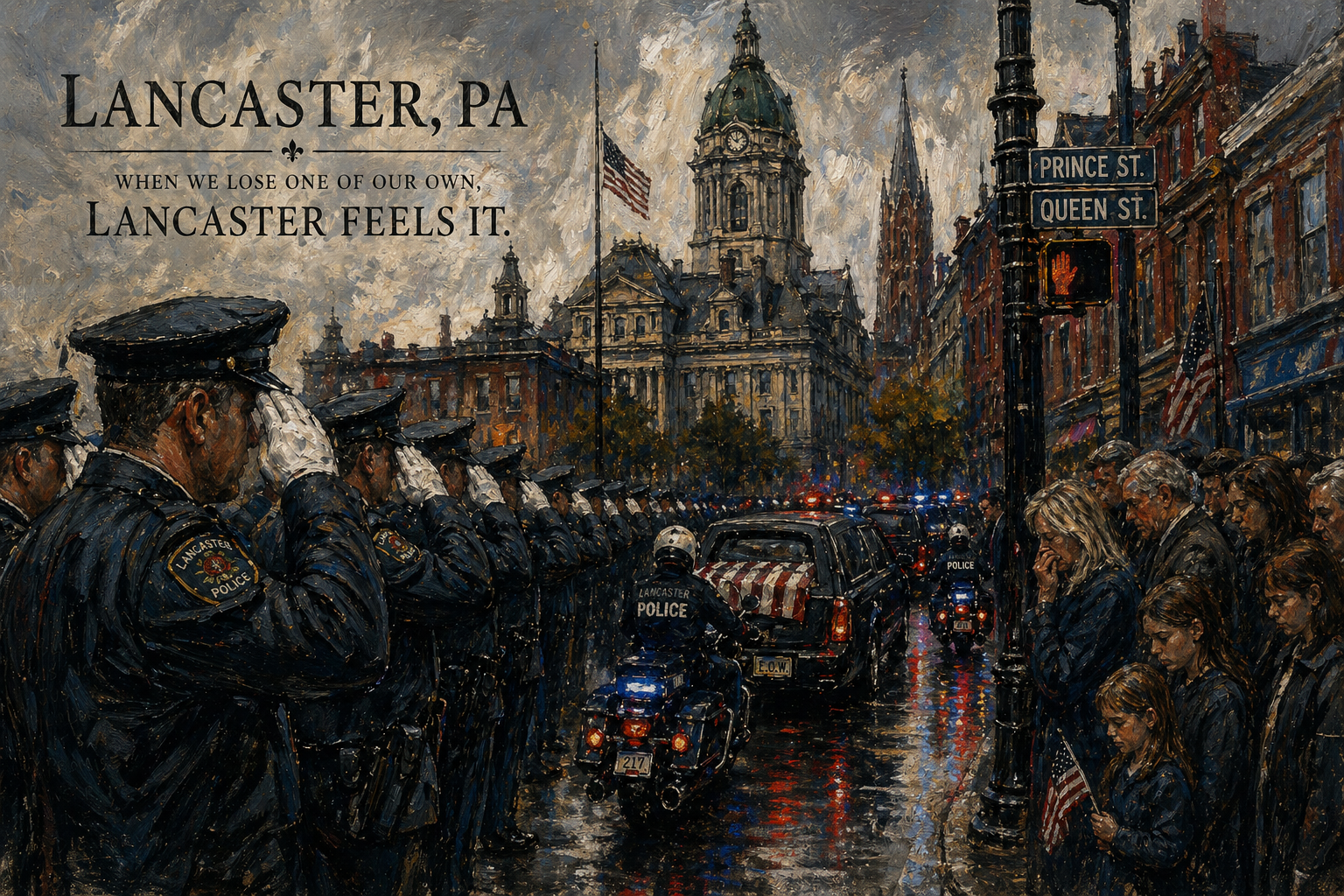
When We Lose One of Our Own, Lancaster Feels It
A community hero is never forgotten. But a department should never have to grieve in silence.
Lancaster is not just a city on a map.
It is a place where people recognize uniforms, faces, patrol cars, K-9 officers, school resource officers, bike patrols, and the men and women who show up when the rest of us are calling for help.
From Lancaster City to Lititz, Manheim Township, Ephrata, Columbia, Millersville, East Petersburg, Strasburg, Mount Joy, Elizabethtown, Lebanon, York, Berks, Chester, and Dauphin County, the badge carries weight here.
Not just because of authority.
Because of proximity.
These officers are not strangers. They are neighbors. Parents. Coaches. Volunteers. Veterans. Church members. Friends. The person directing traffic after a crash. The person standing between chaos and a family on the worst day of their life.
And when one of them is lost, the loss does not stay inside the station.
It moves through the department. Through the family. Through the roll call room. Through the dispatch center. Through the schools. Through the streets they once protected.
It ripples.
The Loss That Does Not Always Make the Headlines
When an officer dies in the line of duty, communities know how to respond. There are processions. Honor guards. Flags. Ceremonies. Public grief.
But when an officer dies by suicide, the grief is often quieter.
Not because the loss is smaller.
Because the pain is more complicated.
Departments carry questions they may never be able to answer. Families carry heartbreak that is difficult to explain. Fellow officers carry memories, guilt, silence, and the weight of wondering if they missed something.
The community may never fully understand the cost.
But the department does.
Lancaster Already Believes in Community Connection
The Lancaster City Bureau of Police has already built real infrastructure around community engagement. Its Office of Community Engagement exists to build trust with residents and businesses through forums, public events, feedback opportunities, and proactive relationship-building. The Bureau also participates in community-facing programs like Coffee with a Cop, National Night Out, Faith and Blue, Shop with a Cop, K-9 demos, Toys for Tots, and other outreach efforts.
That matters.
Because connection is not a soft strategy.
Connection is prevention.
Connection is recruitment.
Connection is trust.
Connection is how a community learns to see officers as human beings before tragedy forces everyone to remember they were human all along.
The Real Cost of Being Unseen
Most people see officers in short, intense moments.
A traffic stop. A call. A crisis. A news story. A social media clip stripped of context.
That is not the full picture.
It leaves officers trapped inside the narrowest version of their public identity.
They become the uniform, not the person.
They become the headline, not the human.
And when officers feel unseen, unsupported, or disconnected from the community they serve, the emotional cost becomes heavier.
This is where departments across Lancaster County and the surrounding region have an opportunity to lead differently.
Blue Line Academy: Making Officers Visible Before the Community Has to Mourn Them
Blue Line Academy is not about turning officers into influencers.
It is about helping departments tell the truth better.
The real truth.
The officer who coaches kids after shift.
The K-9 handler who has a bond with his partner that the public rarely sees.
The school resource officer who becomes a safe adult in a young person’s life.
The patrol officer who has carried more trauma than most people will ever know, but still shows up with professionalism.
The veteran officer who has stories that could teach a new generation what service really means.
The young recruit who chose Lancaster because they wanted purpose, not just a paycheck.
The Hook Lancaster Needs
When we lose one of our own, Lancaster feels it.
But what if the community knew them before the memorial?
What if the public saw their humanity before the funeral procession?
What if the next generation of officers saw a department that does not just recruit people, but reveals them, supports them, and gives them a voice?
That is the heart of Blue Line Academy.
This Is Bigger Than Content
For Lancaster City Police, this is not just a media strategy.
It is a leadership strategy.
It is a recruitment strategy.
It is a community trust strategy.
And it is a wellness strategy.
Because when officers are seen in real, human, consistent ways, something changes.
The community starts to recognize them.
The department starts to feel less isolated.
Young people start to see law enforcement as a calling again.
Families start to understand the person behind the badge.
And officers start to feel that their story matters while they are still here to tell it.
A Community Hero Is Never Forgotten
Every officer who has served Lancaster deserves to be remembered with dignity.
Every officer who has struggled deserves more than silence.
Every officer currently serving deserves to know that their work, their pressure, their sacrifice, and their humanity are seen.
Blue Line Academy exists to help departments build that visibility before crisis, not after it.
Because the next chapter of community policing in Lancaster will not be written only through press releases.
It will be written through faces.
Stories.
Moments.
Truth.
And the courage to let the community see the people behind the badge.
The Next Step
Lancaster has the people.
It has the history.
It has the leadership.
It has the community foundation.
Now it needs the system.
Blue Line Academy gives Lancaster City Police a way to turn community engagement into an ongoing storytelling engine, one that strengthens trust, supports recruitment, honors service, and reminds every officer that they are not invisible.
Because when we lose one of our own, the ripple lasts for years.
But when we lift up one of our own, that ripple can change a community.