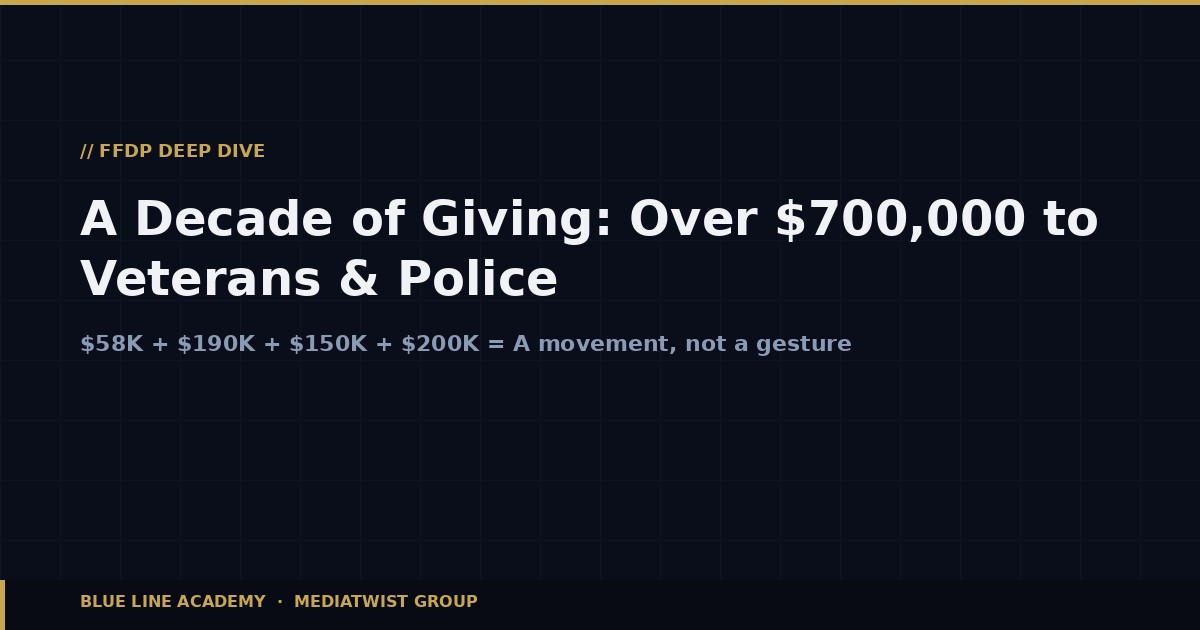
In an industry defined by excess, posturing, and empty gestures toward whatever cause is trending this week, Five Finger Death Punch has maintained a single-minded commitment for over a decade: honoring veterans and first responders with actual money. Not just words. Not just one charity appearance. Not just a benefit concert that gets written off as a tax deduction. Real, sustained, documented donations to organizations that do the work of supporting people who have sacrificed everything.
The total? Over $700,000. The timeframe? More than a decade. The organizations? Some of the most respected veteran and first responder charities in America. The consistency? Unwavering. Here's the complete breakdown of how Five Finger Death Punch became one of the most pro-veteran, pro-first-responder bands in modern rock.
2017: Badge of Honor Memorial Foundation — $58,000
This was FFDP's entry into formalized first responder advocacy. $58,000 doesn't happen by accident. It represents intentional fundraising, deliberate marketing of that fundraising, and commitment to getting money into the hands of families experiencing the worst moment of their lives.
The Badge of Honor Memorial Foundation supports families in the immediate aftermath of officer deaths. These are people in shock, people facing funeral costs they can't afford, people suddenly without a primary income. The money goes directly to people who need it most—not to overhead, not to administration, but to families.
2018: C.O.P.S. and Prevent Child Abuse America — $190,000
This donation represents a significant increase—more than three times the previous year's commitment. It also represents a strategic expansion. By partnering with Breaking Benjamin, FFDP demonstrated that their first responder advocacy transcended individual band ambitions. This was bigger than one artist. It was a movement.
The split between C.O.P.S. and Prevent Child Abuse America shows nuance in FFDP's approach. They're not just funding families of fallen officers. They're funding prevention programs that address root causes of trauma. They're thinking systematically about how to reduce officer deaths and improve community safety.
C.O.P.S. in particular does work that few organizations attempt: they provide grief counseling to people experiencing the absolute worst trauma possible. The loss of a spouse or parent to police work creates psychological wounds that therapy alone can't heal. C.O.P.S. creates peer groups where survivors can talk to other survivors who understand exactly what they're going through.
2019-2020: Gary Sinise Foundation — $150,000
This is where FFDP's strategy reached full maturity. They didn't just donate $150,000. They built an entire collaborative project that generated that $150,000. They convinced multiple artists from different genres to participate. They created a music video. They built marketing around it. They did all of this with 100% of proceeds going directly to the foundation.
The Gary Sinise Foundation, founded by the actor Gary Sinise, is the largest nonprofessional military relief organization in America. They operate at a scale most nonprofits can only dream of. The foundation has built over 80 mortgage-free homes for wounded veterans. They've provided educational scholarships to thousands of military family members. They employ veterans in their own organization.
By routing $150,000 toward GSF, FFDP wasn't just giving money. They were funding a proven organization with a track record of accountability and impact. This wasn't charitybait. It was strategic funding of systematic change.
2024: Covenant House and Call of Duty Endowment — $200,000
This 2024 donation is significant for a reason that extends beyond the dollar amount. It shows that FFDP's commitment hasn't waned after a decade. If anything, it's accelerated. They're not resting on reputation. They're doubling down on impact.
Covenant House addresses the pipeline problem: how many homeless youth are veterans or children of incarcerated parents or members of military families? The organization provides not just shelter but education, job training, mental health services, and long-term support. They understand that homelessness isn't a lifestyle choice—it's often a symptom of larger systemic failures.
Call of Duty Endowment (founded by the video game franchise) focuses on veteran employment. This is crucial because many veterans struggle to translate military skills into civilian job market language. COD Endowment provides career counseling, interview coaching, and direct placement assistance. The result: higher employment rates for veterans, lower homelessness, better long-term stability.
Beyond the Money: The Operational Commitment
The $700,000+ in documented donations only tells part of the story. FFDP's commitment to veterans and first responders extends far deeper:
They employ veterans in their touring crew. This isn't performative. These are actual jobs on an actual touring operation, providing income and sense of purpose to people in transition.
They've performed at military bases worldwide. Not as a marketing tour. As a commitment to play for audiences that can't easily access concerts. They've traveled to bases in Iraq, Afghanistan, and across Europe to perform for troops.
They created the "No One Gets Left Behind" campaign. This wasn't a one-time initiative. It's an ongoing branded program that ties merchandise sales directly to veteran organizations. The campaign collected dog tags from families of deceased veterans and created a memorial wall that travels with the band on tour.
They feature first responders in their music videos. Not as actors. As real people telling real stories. The videos become permanent records of first responder sacrifice.
Zoltan Bathory, FFDP's frontman, has articulated the philosophy directly: "We were always vocal about where we stand when it comes to veterans or first responders. It has been a decade long effort using our platform to raise awareness."
Notice the language: "a decade long effort." Not a one-time gesture. Not a marketing campaign that came and went. A sustained, deliberate, ongoing effort to use their platform for a specific purpose.
Why This Matters for Your Department
You might be reading this as a music industry analysis. That's incomplete. You should read this as a case study in sustained institutional commitment to a mission outside your primary business.
FFDP's primary business is making and selling music. Touring, merchandise, streaming revenue—that's where their resources come from. Yet they've consistently diverted significant resources toward veterans and first responders because they identified something larger than their business: people deserve to be honored for their sacrifice.
Your department's primary business is public safety. Yet your officers' humanity deserves to be honored too. Your community deserves to see the people behind the badges. Your department deserves to have its culture shaped by authentic recognition of officer dedication.
That's what Blue Line Academy provides. Not as a one-time marketing initiative, but as a sustained framework for building authentic representation of your officers, consistent engagement with your community, and systematic documentation of the values your department embodies.
FFDP proved that you can build a reputation—globally, across multiple demographics, across decades—by being consistently, relentlessly, unapologetically committed to honoring people who serve. Your department can do the same thing locally. It starts with deciding that your officers' stories matter enough to document professionally.
The Compounding Effect of Consistency
Here's what's remarkable about FFDP's track record: they didn't make a big splash once and disappear. They donated in 2017, then again in 2018, then again in 2019-2020, then again in 2024. The donations compound. The credibility compounds. The community trust compounds.
When FFDP announces a new veteran initiative now, people believe them. They've proven themselves through a decade of action. They've backed up their words with resources. They've created a track record.
That's the model for your department. One reaction video is good. Five is better. Ten is a pattern. Twenty is a movement. Fifty becomes culture. The compounding effect—each piece of content reinforcing the previous one, building toward a coherent narrative about what your department stands for—is where transformation happens.
Five Finger Death Punch donated $700,000 over a decade because they believed veterans and first responders deserve to be honored. Your department can build that same culture, right now, by choosing to honor your officers authentically and consistently.
The framework exists. The model is proven. The only question is whether you'll commit to it.
Book Your Department's Reaction Session