The Boost Button Is a Trap (And Here's Why)
Let's be direct: if you're clicking "Boost Post" on Facebook or Instagram, you're lighting money on fire. Every single boost is premium pricing for the least sophisticated, least effective form of paid social advertising that exists. It's the equivalent of handing your media budget to a casino and hoping for the best.
Here's why: Boost directs your budget to Facebook's optimization algorithm, which doesn't care about your real KPIs. It cares about engagement (likes, comments, shares). Engagement is not conversion. A post can get 10,000 likes and generate zero revenue. Boost optimizes for the wrong metric, so you're paying premium prices for the wrong outcome.
Meanwhile, brands like Kellogg's and West Shore Home — and practically every Fortune 500 brand — invest in full-funnel conversion architecture that a $5 boosted post can never compete with. That's the gap between brands that think social and brands that think revenue.
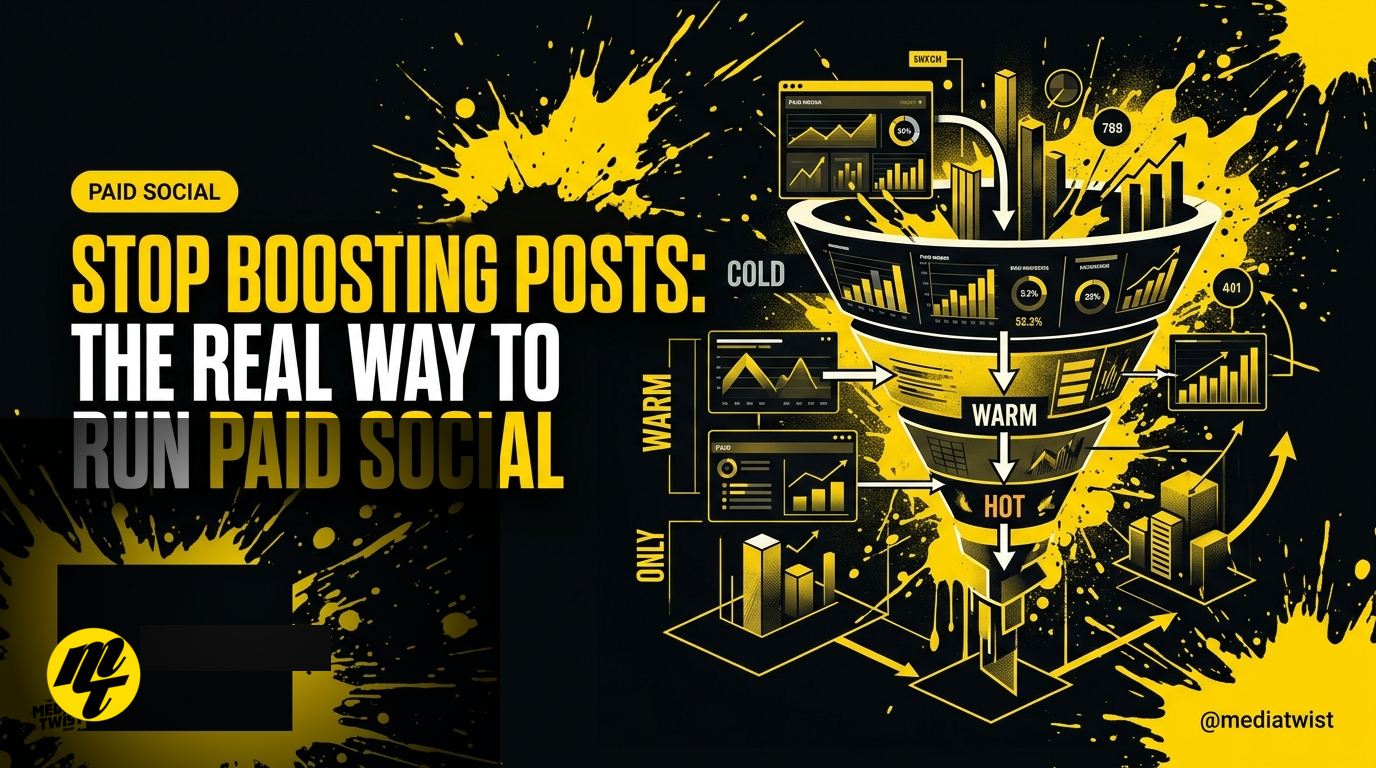
The Paid Social Funnel: How Real Brands Do It
Professional paid social isn't a single ad. It's a sequence. It's a system. Here's the architecture that converts:
Layer 1: Cold Awareness
Broad audiences, brand awareness messaging, low price-per-impression. Goal: reach people who don't know you exist. Use lookalike audiences (drawn from your customer CRM), broad interest targeting, or geofenced audiences at competitor locations. Don't expect immediate conversion. You're introducing your brand. Budget: 20-30% of total spend.
Creative Strategy: Stop-the-scroll hooks, pattern interrupts, bold claims, credibility signals (logos, awards, testimonials). You're fighting for attention in a feed of 50 other ads.
Layer 2: Warm Engagement
Audience: people who saw your awareness ad but didn't convert. Showed interest (video view ≥ 25%, link click, carousel interaction, landing page visit for 3+ seconds). Message: "You looked interested, here's more." Solution-focused, educational, pain-point focused. Goal: move them from "aware" to "considering."
Budget: 40-50% of total spend. This is where the conversion starts. Someone in the warm layer is 5-10x more likely to convert than someone in the cold layer.
Creative Strategy: Case studies, how-to content, comparisons, ROI calculators, demo videos. Show, don't tell. Prove it works.
Layer 3: Hot Conversion
Audience: people who engaged with warm content, visited your site multiple times, added items to cart, viewed pricing pages, watched demo videos for 75%+ completion. These are ready-to-buy. They're not doubting the product. They're doubting the decision. Message: remove friction. Offer guarantees, case studies, customer testimonials, special offers. Goal: convert to customer.
Budget: 20-30% of total spend. Highest ROI layer because you're reaching the most qualified audience.
Creative Strategy: Social proof, scarcity (limited-time offers), guarantees, direct CTA, clear next steps. Make the conversion decision trivially easy.
Audience Segmentation: The Secret No One Talks About
The real difference between a $1,000 boosted post and a $1,000 conversion-optimized campaign? Audience precision. Here's how professionals segment:
Customer Segment (Audience: existing customers)
Upsell, cross-sell, loyalty messaging. They already trust you. Message: "Here's what else you could buy." Conversion rate: 5-15%. Budget allocation: small, but high ROI.
High-Intent Segment (Audience: website visitors, app users, email list, people who engaged with 3+ content pieces)
These people are already thinking about you. Remarketing, conversion messaging. Conversion rate: 2-8%. Budget allocation: 20-25%.
Consideration Segment (Audience: video viewers, content engagers, carousel clickers, people who spent 10+ seconds on your ad)
They know you exist. They're evaluating. Education-focused messaging. Conversion rate: 0.5-2%. Budget allocation: 40-50%.
Awareness Segment (Audience: lookalikes, interests, broad demographics)
Cold audience, brand awareness messaging. Conversion rate: 0.05-0.2%. Budget allocation: 20-30%.
A boost post? It goes to Facebook's algorithm, which doesn't know the difference. It reaches a random mix of all four segments with the same message. Conversion rate: 0.1-0.3%. That's why it fails.
Creative Strategy: Why Most Paid Social Fails
You can have perfect audience segmentation and still fail if your creative sucks. Here's what works:
Awareness Creative
- Controversial, provocative headlines that disrupt the feed
- Pattern-interrupt imagery or video (unexpected, bold, high contrast)
- Fast cuts, bold text, movement in first 1 second
- Clear value prop in headline (not headline + copy)
- CTA: "Learn More" or "Watch" (low-friction)
Consideration Creative
- Detailed value prop, feature-focus, specificity (not vague benefits)
- Social proof: customer logos, testimonials, metrics ("$2M saved," "94% faster," "3x ROI")
- Problem-solution format: "You have X problem. We solve it. Here's how."
- Demo footage, walkthrough, or case study narrative
- CTA: "See Demo" or "Read Case Study" (mild friction, but qualified)
Conversion Creative
- Customer testimonials, video case studies, reviews (trust-building)
- Guarantee messaging, risk-removal ("30-day free trial," "Money-back guarantee")
- FOMO or scarcity: limited-time offer, limited spots, deadline
- Clear pricing (transparency builds trust), clear next step
- CTA: "Sign Up," "Buy Now," "Start Free Trial" (high-friction, but converting)
Attribution & Measurement: Why Boosts Fail Again
Boost posts hide data. You get vanity metrics: "Reached 50,000 people, 1,200 likes." But did it convert? Boost doesn't track conversions well. Professional campaigns track everything: impressions, clicks, CTR, landing page views, conversion events (signups, purchases), ROAS, CAC, LTV.
We structure every campaign with proper conversion tracking — Facebook Pixel, conversion API, UTM parameters, CRM integration. So you know exactly what your social spend generated. A boost? You're flying blind.
The Real Way to Run Paid Social
It looks like this:
- Define your conversion goal (purchase, signup, demo booking, phone call)
- Build audience segments (customer, high-intent, consideration, awareness)
- Create 3-4 creative variations per segment (test, learn, optimize)
- Set bids based on value per conversion, not engagement
- Monitor daily, optimize underperforming segments/creatives
- Attribution: which segments + creatives drove conversions?
- Scale what works, pause what doesn't
- Repeat weekly for 4-6 weeks until you find the winning formula
Boost posts skip all of that. They're the lazy way. The expensive way. The ineffective way.
Budget Example: $1,000/Month
Boost Approach: One $1,000 boosted post. Reach: 25,000. Engagement rate: 3% (750 people engaged). Conversions: maybe 3-5. Cost per conversion: $200-$330. ROI (assuming $100 per customer value): -67% to -70%. You lost money.
Professional Approach: Same $1,000 budget, broken down:
- Awareness creative ($300): 80,000 reach, 2,400 engagements, 240 website visits
- Consideration video ($400): 180 warm-audience views, 30 conversions
- Retargeting ($200): 20 high-intent viewers, 5 conversions
- Lookalike ($100): Scaling awareness for next month
Total conversions: 35+. Cost per conversion: $28. Assuming $100 per customer value: $3,500 revenue from $1,000 spend. ROI: 250%.
That's not exaggeration. That's the standard gap between amateur (boosts) and professional (funnel-based) paid social.
Common Objections (And Why They're Wrong)
"Boosts are simple and fast."
Yes. So is driving drunk. Speed isn't the goal. Results are. Spend 30 minutes on proper campaign setup and you'll make 10x the return of a boost.
"Facebook recommends boosts."
Facebook recommends boosts because boosts pay premium prices and optimize for engagement (which keeps people on platform longer). Facebook isn't optimizing for your profit. It's optimizing for theirs. Don't listen to the platform. Listen to the data.
"I don't have time for all that complexity."
Then let us handle it. We do this for dozens of brands simultaneously. It's our standard playbook. Complexity is our job. Your job is to focus on product, service, and customers. But don't let time pressure trick you into boosts. That's guaranteed waste.
The Path Forward
If you're currently boosting posts, you're leaving 10x revenue on the table. Stop. Immediately. Move to funnel-based, segmented, conversion-optimized paid social. We build this for brands constantly. Let's schedule a 30-minute conversation about your paid social strategy. We'll show you the gap between where you are and where you could be. The numbers will shock you.